
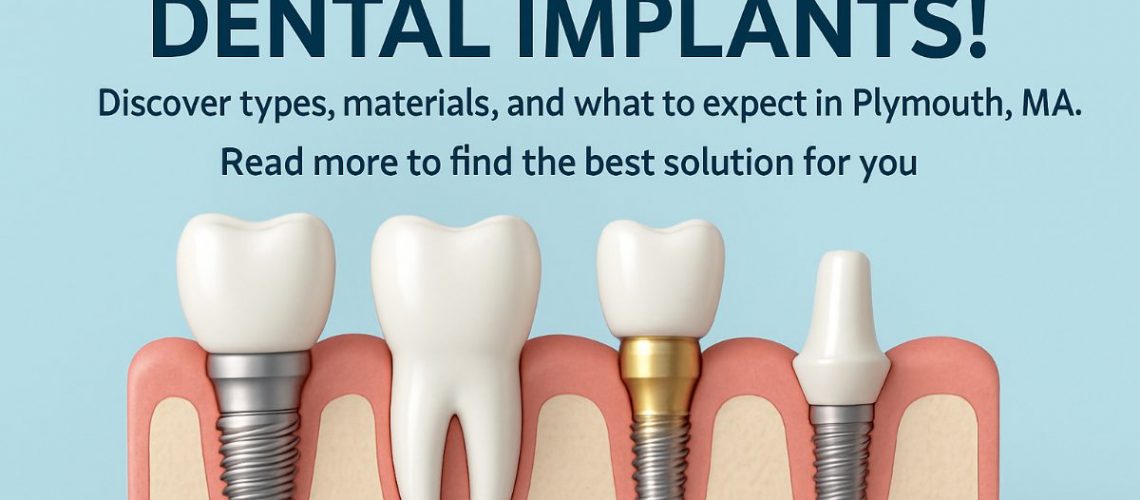
Considering tooth replacement? This article, "What Are All The Different Dental Implant Types?", explains common options so you can make a smart choice. Early on we’ll cover why dental implants matter, the main styles and materials, and what to expect if you pursue care near Plymouth, MA.
Types of dental implants by placement and design
Implants are grouped by how they sit in the mouth and which bone they use. Choice depends on bone shape, bone volume, and the number of missing teeth.
Endosteal implants (most common)
Endosteal implants are placed directly into the jawbone. They look like small screws or cylinders and support single crowns, bridges, or full-arch prosthetics. Most patients who have enough healthy jawbone get endosteal implants.
Subperiosteal implants
Subperiosteal implants sit on top of the jawbone but under the gum. They are used when bone height is low and the patient cannot—or prefers not to—have bone grafting. These are less common today but still useful in select cases.
Zygomatic implants (for severe bone loss)
Zygomatic implants anchor into the cheekbone (zygoma) instead of the upper jaw. They’re for patients with severe upper jaw bone loss who want a fixed full-arch solution without extensive grafting.
Mini dental implants
Mini implants are narrower than standard implants. They can stabilize dentures or replace small teeth where space is limited. They’re less invasive and sometimes used as a temporary or lower-cost option.
Types of dental implants by function: single, multiple, and full-arch solutions in Plymouth, MA
Function influences the implant plan. Whether you need one tooth or a whole arch, the implant type and prosthetic design change both the experience and outcome.
Single-tooth dental implants in Plymouth, MA
One implant topped with a crown replaces a single missing tooth. This conserves nearby teeth and restores bite and appearance like a natural tooth.
Implant-supported bridges and multiple-tooth solutions in Plymouth, MA
When several teeth are missing in a row, two or more implants can support a bridge. This avoids altering healthy adjacent teeth and provides better chewing strength than removable options.
Full-arch / All-on-4 and All-on-X dental implants in Plymouth, MA
Full-arch solutions use a small number of implants (often four or more) to support a complete set of upper or lower teeth. These systems can often be loaded the same day with a temporary prosthesis and offer a fixed, stable result.
Implant-retained overdentures in Plymouth, MA
Overdentures snap onto implants for much better stability than traditional dentures. They’re removable for cleaning but feel more secure for chewing and speaking.
Materials and components of dental implants in Plymouth, MA
Materials and design affect strength, look, and how well implants last. Ask your clinician about options that match your health and cosmetic goals.
Titanium vs. zirconia implants
Titanium is the long-standing gold standard — very strong and well-studied. Zirconia is metal-free, white, and may be preferred for certain cosmetic cases or metal sensitivities. Both integrate with bone when placed properly.
One-piece vs. two-piece systems and abutment types
One-piece implants combine the implant and abutment in a single unit. Two-piece systems have a separate abutment, giving more prosthetic flexibility. Choices affect healing, access for repairs, and cosmetic outcomes.
Surface treatments, coatings, and how they help integration
Implant surfaces are treated or coated to speed bone bonding (osseointegration). Roughened surfaces, plasma sprays, and special coatings can improve stability and long-term success.
How clinicians pick the right dental implants for you
Clinicians weigh bone volume, oral and overall health, bite and esthetic goals, timeline, and budget. They also consider smoking, diabetes, and medications that affect healing.
Diagnostic tools guide selection:
- 3D cone-beam CT scans for bone volume and anatomy
- Digital planning software and surgical guides for precise placement
- Intraoral scanning for accurate prosthetic design
Sedation and healing aids may include IV sedation, nitrous oxide, oral sedation, and biologics like platelet-rich plasma (PRP) to support tissue healing.
Risks, recovery, FAQs, and next steps for dental implants in Plymouth, MA
Dental implant care is common and predictable, but like any surgery there are risks and a recovery process to follow.
- Common risks: infection, temporary swelling or bruising, nerve irritation, implant failure (rare)
- How risks are managed: careful planning, sterile technique, antibiotics when needed, and follow-up visits
Typical healing timeline and what to expect
Initial healing takes 1–2 weeks for soft tissue. Bone integration usually takes 3–6 months before final restorations, though some full-arch protocols use immediate temporaries. Expect follow-up visits for checks and adjustments.
Link 8: what to expect
Top FAQs: pain, success rates, cost range, longevity
Pain is usually managed with short-term medications. Success rates for standard implants are high (often above 95% for healthy patients). Costs vary by type, number of implants, and any grafting; discuss estimates with your clinician. With good care, implants can last decades.
Link 9: FAQs
When to consult a specialist about dental implants in Plymouth, MA
See a specialist if you have complex bone loss, multiple missing teeth, prior failed implants, significant medical issues, or if you want full-arch, same-day options. A specialist can offer advanced techniques and sedation choices.
Looking for dental implants in Plymouth, MA? About Lane Oral Surgery and how we help
Lane Oral Surgery has over 35 years of experience and a four-doctor team focused on implant care and complex surgery. The practice offers in-house imaging, SmileOn! same-day implant options, PRP to support healing, and multiple anesthesia choices (IV sedation, nitrous, oral sedation). Financing and patient resources are available across Plymouth, Sandwich, and Bourne.
If you’re ready to learn which dental implants are best for you, schedule a consultation to review options and get a personalized treatment plan.